This is one of the most common and trivial challenges that developers face in any enterprise application development – How to store passwords in database in a safe and secure manner?
It’s common sense to reconcile that passwords should not be stored as plain text as it would be possible for anyone to hack the passwords if he has access to the database table.
One option is to encrypt the passwords using a symmetric key and decrypting it for comparison during password authentication. But then we have the problem of securely storing the secret symmetric key, because if the key were compromised all the passwords would become accessible.
The most common and simple solution to this problem is to ‘hash’ the passwords before storing it in database. MD5 or SHA-1 hash algorithms can be used to perform a one-way hash of the password. To compare passwords for authentication, you retrieve the password entered by the user and hash it; then you compare the hashed value with the hashed value in the database. This method is quite foolproof and safe as it’s impossible to convert a hashed entry into its original value.
But still it possible for a hacker to perform a brute-force dictionary attack on the passwords and guess some passwords. More info on this here.
To hinder the risk of a dictionary attack, it is important that password contain special characters that are difficult to guess. Another option is to ‘salt’ the password before hashing it. Salting the password means adding some padding data in front or back of the password to create a new string that is hashed and put inside the database table. This padding data could be a random generated number or the userID of the user itself. This makes the dictionary attack much difficult to succeed.
Recently there was a lot of furor over the security of MD5 algorithm. The problem is that of MD5 hash collisions. The problem that arises is the following:
Since what we did is take the characters in some text, however many they are, and producing 128 characters out of them somehow, there will be lots of texts that give the same set of 128 characters, and hence have the same MD5 value. I.e. the hash-function is not 1-1 as we say. So how do we know that the file we received is not one of those other millions of files that have the same MD5 value? The simple answer is, we don’t. But what we believe is that the chance that this other file will be meaningful is miniscule. In other words, we believe that even if someone were to tamper with our file on its way to us, they would not be able to produce a file that has the same MD5 value and can harm u.
But the site below shows how two different postscript files end up having the same MD5 hash. http://www.cits.rub.de/MD5Collisions/
So, what are the other options? Tiger and SHA-2 are still considered to be safe hash functions to use. One could possibly also apply a number of hash-functions to the same file, as secondary checks.
Tuesday, April 18, 2006


Monday, April 10, 2006
Uses of Reverse Proxy
We are all aware of proxy servers, that enable us to access the internet from inside a firewall. These proxies are known as forward proxies. Similarly we have reverse proxy that sits in front of a webserver and can provide caching and also redirection.
Recently, we needed to expose a website to the internet. I thought the only way of doing it would be to assign a new IP to the webserver machine and have a DNS setup for it. Alternatively, we can put in one more NIC card and have that IP address exposed to the public.
But Reverse Proxy presents us with an interesting alternative. A reverse proxy can be used to enable controlled access from the Web at large to servers behind a firewall.
Here is a simple example provided at the Apache website (Apache can also be used as a reverse proxy server)
Scenario:
Company example.com has a website at www.example.com, which has a public IP address and DNS entry can be accessed from anywhere on the Internet.
The company also has a couple of application servers which have private IP addresses and unregistered DNS entries, and are inside the firewall. The application servers are visible within the network - including the webserver, as "internal1.example.com" and "internal2.example.com", But because they have no public DNS entries, anyone looking at internal1.example.com from outside the company network will get a "no such host" error.
A decision is taken to enable Web access to the application servers. But they should not be exposed to the Internet directly, instead they should be integrated with the webserver, so that http://www.example.com/app1/any-path-here is mapped internally to http://internal1.example.com/any-path-here and http://www.example.com/app2/other-path-here is mapped internally to http://internal2.example.com/other-path-here. This is a typical reverse-proxy situation.
--------------------------------------------------
In my scenario, my network admin guys were able to put my website on the internet without touching my server even once :)
For more information on reverse proxy check out the following links:
http://www.apacheweek.com/features/reverseproxies
http://www.informit.com/articles/article.asp?p=169534&rl=1
http://en.wikipedia.org/wiki/Reverse_proxy
Recently, we needed to expose a website to the internet. I thought the only way of doing it would be to assign a new IP to the webserver machine and have a DNS setup for it. Alternatively, we can put in one more NIC card and have that IP address exposed to the public.
But Reverse Proxy presents us with an interesting alternative. A reverse proxy can be used to enable controlled access from the Web at large to servers behind a firewall.
Here is a simple example provided at the Apache website (Apache can also be used as a reverse proxy server)
Scenario:
Company example.com has a website at www.example.com, which has a public IP address and DNS entry can be accessed from anywhere on the Internet.
The company also has a couple of application servers which have private IP addresses and unregistered DNS entries, and are inside the firewall. The application servers are visible within the network - including the webserver, as "internal1.example.com" and "internal2.example.com", But because they have no public DNS entries, anyone looking at internal1.example.com from outside the company network will get a "no such host" error.
A decision is taken to enable Web access to the application servers. But they should not be exposed to the Internet directly, instead they should be integrated with the webserver, so that http://www.example.com/app1/any-path-here is mapped internally to http://internal1.example.com/any-path-here and http://www.example.com/app2/other-path-here is mapped internally to http://internal2.example.com/other-path-here. This is a typical reverse-proxy situation.
--------------------------------------------------
In my scenario, my network admin guys were able to put my website on the internet without touching my server even once :)
For more information on reverse proxy check out the following links:
http://www.apacheweek.com/features/reverseproxies
http://www.informit.com/articles/article.asp?p=169534&rl=1
http://en.wikipedia.org/wiki/Reverse_proxy
Thursday, April 06, 2006
Unix Quirks for Windows developers
Recently came across a wonderful blog stating a few things about Unix/Linux which ever developer should know. The link to the blog is here.
Some useful points in the blog were:
Some useful points in the blog were:
- In Unix, if U want Ur application or server to use a port less than 1024, then U must be running as 'root'. This imposes security risks !!!
- In Unix, it is possible for one process to open a file stream and an another process to delete the same file. (Windows does a automatic file lock). For the same reason, in Unix, U can delete a directory right from under it.
- Equivalent of Windows services in the Unix world are just plain shell scripts that are mentioned in the /etc/init.d directory.
- The Unix shell runs scripts by creating a copy of itself and running the script in the new shell. This new shell will read in the script, perform all the steps in the script (e.g. set all the environment variables) and then exit, leaving the original shell and its environment unchanged. So to run scripts in the same shell, we need to type ". setenv.sh" For c-shell, we need to type "source setenv.sh"
- And last, but not the least, every developer learns early - Unix new line character is \n and on Windows \r\n.
Saturday, April 01, 2006
Debugging JavaScript
While working with VisualStudio.NET, I was impressed with the ability of VS.NET to even debug JavaScript on a HTML page. It saved a lot of time - or the other alternative was writting alert() statements.
I wondered if there was some similar JavaScript Debugger tool for the Java community.
Fortunately, Mozilla has come up with a cool tool that allows developers to debug Javascript code. The tool is "Venkman Debugger" and it's a free download.
Here's the URL for more details: http://www.mozilla.org/projects/venkman/
For firefox 1.0 (my fav browser), the debugger is available as a plug-in. Installation was a breeze !!!
I just had to download the *.xpi" file and drag and drop the file in a open window of Firefox...that's it..Then start the debugger from the tools menu...
After this, any page U see on Firefox - the debugger windows will show all the Javascript functions and we can set breakpoint and step thru the code...also available is the local window and watch window :)
Happy debugging..
I wondered if there was some similar JavaScript Debugger tool for the Java community.
Fortunately, Mozilla has come up with a cool tool that allows developers to debug Javascript code. The tool is "Venkman Debugger" and it's a free download.
Here's the URL for more details: http://www.mozilla.org/projects/venkman/
For firefox 1.0 (my fav browser), the debugger is available as a plug-in. Installation was a breeze !!!
I just had to download the *.xpi" file and drag and drop the file in a open window of Firefox...that's it..Then start the debugger from the tools menu...
After this, any page U see on Firefox - the debugger windows will show all the Javascript functions and we can set breakpoint and step thru the code...also available is the local window and watch window :)
Happy debugging..
Friday, March 31, 2006
Diff btw div and span tags in HTML
I was trying to get the hang of AJAX and was learning a lot of JavaScript and HTML. I was confused btw the <div>and <span> tags in HTML. A quick google came up with these answers:
The main difference between <div> and <span>is that <div>defaults as a block-level element and <span>defaults as an inline element.
Block-level elements create a new formatting context. They are stacked vertically(acts as a paragraph break) in the order they appear in the source code and may contain any number of other block-level elements or inline elements.
Inline elements do not create a new formatting context. They line up horizontally within their block container in the order they appear in the source code, wrapping to new lines within their block container if necessary and can contain only other inline level elements (or inline text boxes).
Both <div> and <span>are generic elements. Both can be used as many times as you like on a page. They hold no defaults settings besides their value for display (block on <div>, inline on <span>)
The main difference between <div> and <span>is that <div>defaults as a block-level element and <span>defaults as an inline element.
Block-level elements create a new formatting context. They are stacked vertically(acts as a paragraph break) in the order they appear in the source code and may contain any number of other block-level elements or inline elements.
Inline elements do not create a new formatting context. They line up horizontally within their block container in the order they appear in the source code, wrapping to new lines within their block container if necessary and can contain only other inline level elements (or inline text boxes).
Both <div> and <span>are generic elements. Both can be used as many times as you like on a page. They hold no defaults settings besides their value for display (block on <div>, inline on <span>)
Friday, March 24, 2006
Debugging Server-side Java with JPDA
JPDA stands for Java Platform Debugger Architecture. It is a new debugging design adopted by the VM that facilitates debuggers to attach to the VM process easily. More info about JPDA can be found here.
I tried out debugging a Struts application running on Tomcat using Eclipse. (Versions: Tomcat-5.0; Eclipse-3.1.2)
Here are the steps to be followed:
I tried out debugging a Struts application running on Tomcat using Eclipse. (Versions: Tomcat-5.0; Eclipse-3.1.2)
Here are the steps to be followed:
- Start Tomcat in JPDA debug mode. For this, set up two variables in the environment as follows:
- The first variable is: set JPDA_TRANSPORT=dt_socket (This tells the VM that the debugger would talk to the VM on Tcp sockets)
- The second variable is: set JPDA_ADDRESS=8000 (This tells the VM the port on which it should listen for debugger connections)
- Go to the command prompt and run the 'Catalina.bat' batch file present in {TomcatHome}\bin. On the command prompt pass the following argument: catalina jdpa start
- Go to Eclipse and open the Debug window. Create a new configuration under 'Remote Java Application' . Make sure 'Connection Type' is Socket and port is 8000
- Navigate the webapplication thru web browser and see Ur Eclipse stop at breakpoints..
Happy debugging............
Precompiling JSPs in Tomcat
For faster startup access to a website, it is sometimes desirable to precompile all the JSP pages on a production server, so that the first users of the website do not have to bear the performance hit of JSP compilation (first to servlet java file and then to class file)
Tomcat 5.0 and above comes with a cool ANT script that uses the Jasper JSP compiler to precompile the JSPs in a webapp. The ANT script is available here.
On running the ANT script, the "WEB-INF\classes" directory has a new package "\org\apache\jsp" that contains all the class files of the compiled JSPs. The src folder would contain the generated Java Servlet files.
If U edit a JSP page on the fly, then it would again be compiled at run-time and swapped in memory with the old one, but the classes directory would still contain the old class file.
Tomcat 5.0 and above comes with a cool ANT script that uses the Jasper JSP compiler to precompile the JSPs in a webapp. The ANT script is available here.
On running the ANT script, the "WEB-INF\classes" directory has a new package "\org\apache\jsp" that contains all the class files of the compiled JSPs. The src folder would contain the generated Java Servlet files.
If U edit a JSP page on the fly, then it would again be compiled at run-time and swapped in memory with the old one, but the classes directory would still contain the old class file.
Monday, March 20, 2006
StringBuffer Myth
I have noticed that a lot of people are wasting their precious time changing code that contains "+" overloaded String operator toStringBuffer...in the following way :
For eg.
-----------------
1 ) String sTemp = "a" + "b" + "c";is being replaced with
---------------
2 )StringBuffer sBuffer = new StringBuffer()
sBuffer.append("a");
sBuffer.append("b");
sBuffer.append("c");
String sTemp = sBuffer.toString();
Now the point is for simple string concatenations such as the above the compiler itself does the conversion to StringBuffer. Thus the code in 1) gets converted to code in 2) during compilation time only.......ie conversion to platform independant byte form...
So there is no need for us to do this explictly....But yes, there will be a remarkable advantage when we have String concatenation in a for loop...
for eg, if the above code was within a for loop.....for eg:
for(int i=0;i<n;i++)
{ sTemp = "a" + "b" + "c";}
Then it makes sense to use StringBuffer, otherwise a new String Buffer object will be created for each iteration of the loop. So in such cases we can instantiate the StringBuffer outside the loop and just use "append" inside the loop..
For eg.
-----------------
1 ) String sTemp = "a" + "b" + "c";is being replaced with
---------------
2 )StringBuffer sBuffer = new StringBuffer()
sBuffer.append("a");
sBuffer.append("b");
sBuffer.append("c");
String sTemp = sBuffer.toString();
Now the point is for simple string concatenations such as the above the compiler itself does the conversion to StringBuffer. Thus the code in 1) gets converted to code in 2) during compilation time only.......ie conversion to platform independant byte form...
So there is no need for us to do this explictly....But yes, there will be a remarkable advantage when we have String concatenation in a for loop...
for eg, if the above code was within a for loop.....for eg:
for(int i=0;i<n;i++)
{ sTemp = "a" + "b" + "c";}
Then it makes sense to use StringBuffer, otherwise a new String Buffer object will be created for each iteration of the loop. So in such cases we can instantiate the StringBuffer outside the loop and just use "append" inside the loop..
Retrieval of AutoGenerated Keys
We often face the problem of retrieving a 'auto-generated' column after a 'INSERT' operation. For e.g.
insert into myTable (name) values ('Naren')");
Now immediately after the insert, I want to get the 'auto-generated' key of the inserted row. The only way to do it earlier in JDBC was to fire another query to get the last inserted row. But this method is fundamentally flawed, as there could be other inserts that have happened in-between.
Now, in JDBC 3.0 (in JDK 1.4), we have core JDBC methods that enable us to retrive the autogenerated key automatically. For e.g.
int rowcount = stmt.executeUpdate("sql here...",Statement.RETURN_GENERATED_KEYS);
ResultSet rs = stmt.getGeneratedKeys ();
The ability to retrieve auto generated keys provides flexibility to the JDBC programmer and it provides a mechanism to realize performance boosts when accessing data.
The following methods are available since JDK 1.4
public int executeUpdate(String sql, int autoGeneratedKeys) throws SQLException
Executes the given SQL statement and signals the driver with the given flag about whether the auto-generated keys produced by this Statement object should be made available for retrieval.
Parameters:
sql - must be an SQL INSERT, UPDATE or DELETE statement or an SQL statement that returns nothing.
autoGeneratedKeys - a flag indicating whether auto-generated keys should be made available for retrieval; one of the following constants: Statement.RETURN_GENERATED_KEYS
Statement.NO_GENERATED_KEYS
---------------------------------------
public int executeUpdate(String sql, int[] columnIndexes)
throws SQLExceptionExecutes the given SQL statement and signals the driver that
the auto-generated keys indicated in the given array should be made available for retrieval. The driver will ignore the array if the SQL statement is not an INSERT statement.
Parameters:
columnIndexes - an array of column indexes indicating the columns that should be returned from the inserted row
------------------------------------------
public int executeUpdate(String sql, String[] columnNames)
throws SQLExceptionExecutes the given SQL statement and signals the driver that
the auto-generated keys indicated in the given array should be made available for retrieval. The driver will ignore the array if the SQL statement is not an INSERT statement.
Parameters:
columnNames - an array of the names of the columns that should be returned from the inserted row
----------------------------------------
In Spring JDBC API, the JDBCTemplate has a utility method that directly gives the genetated key:
int update(PreparedStatementCreator psc, KeyHolder generatedKeyHolder)
insert into myTable (name) values ('Naren')");
Now immediately after the insert, I want to get the 'auto-generated' key of the inserted row. The only way to do it earlier in JDBC was to fire another query to get the last inserted row. But this method is fundamentally flawed, as there could be other inserts that have happened in-between.
Now, in JDBC 3.0 (in JDK 1.4), we have core JDBC methods that enable us to retrive the autogenerated key automatically. For e.g.
int rowcount = stmt.executeUpdate("sql here...",Statement.RETURN_GENERATED_KEYS);
ResultSet rs = stmt.getGeneratedKeys ();
The ability to retrieve auto generated keys provides flexibility to the JDBC programmer and it provides a mechanism to realize performance boosts when accessing data.
The following methods are available since JDK 1.4
public int executeUpdate(String sql, int autoGeneratedKeys) throws SQLException
Executes the given SQL statement and signals the driver with the given flag about whether the auto-generated keys produced by this Statement object should be made available for retrieval.
Parameters:
sql - must be an SQL INSERT, UPDATE or DELETE statement or an SQL statement that returns nothing.
autoGeneratedKeys - a flag indicating whether auto-generated keys should be made available for retrieval; one of the following constants: Statement.RETURN_GENERATED_KEYS
Statement.NO_GENERATED_KEYS
---------------------------------------
public int executeUpdate(String sql, int[] columnIndexes)
throws SQLExceptionExecutes the given SQL statement and signals the driver that
the auto-generated keys indicated in the given array should be made available for retrieval. The driver will ignore the array if the SQL statement is not an INSERT statement.
Parameters:
columnIndexes - an array of column indexes indicating the columns that should be returned from the inserted row
------------------------------------------
public int executeUpdate(String sql, String[] columnNames)
throws SQLExceptionExecutes the given SQL statement and signals the driver that
the auto-generated keys indicated in the given array should be made available for retrieval. The driver will ignore the array if the SQL statement is not an INSERT statement.
Parameters:
columnNames - an array of the names of the columns that should be returned from the inserted row
----------------------------------------
In Spring JDBC API, the JDBCTemplate has a utility method that directly gives the genetated key:
int update(PreparedStatementCreator psc, KeyHolder generatedKeyHolder)
Sunday, March 19, 2006
When to do Object Pooling?
Pooling basically means utilizing your resources better. For example, imagine a fairly large
number of clients utilizing a small number of database or network connections efficiently. By
limiting object access to only the period when the client requires it, you can free resources for
use by other clients. Increasing utilization through pooling usually increases system
performance.
You can use pooling to minimize costly initializations. Typical examples include database and
network connections and threads. Such connections often take a significant amount of time to
initialize. You can achieve significant savings by creating these connections once and reusing
them later. Finally, you can pool objects whose initialization is expensive, in terms of time,
memory, or other resources. For example, most containers pool Enterprise JavaBeans to avoid
repeated resource allocation and state initialization.
Examples of objects holding external OS resources:
-database connection pooling,
- socket connection pooling (including HTTP, RMI, CORBA, WS, etc...)
- thread pooling,
- bitmaps, fonts, other graphics objects...
For objects that do not hold external OS resources, but are time-consuming to initialize and are
memory-heavy, a cost benefit analysis needs to be done. What is the cost of pooling
(synchronization, management, GC etc.) vs the benefit (quick access to connection or socket).One very important concern during pooling is the problem of concurrency bottlenecks....when we snchronize access to the pooled resources.
Simple object pooling (which hold no external resources, but only occupy memory) could be a
waste, as the performance improvments in the latest versions of the JVM have tilted this
equation, so we better re-evaluate what we think we know........There was also an old school of thought that pooling reduces the need of GC and hence improves the performance. But with the introduction of the concept of 'generations' to GC algorithms, it is possible that pooled resources would be more difficult to GC as they are put in older generations of objects.
But for external resources the JVM improvements are of no-concern. Whether objects holding
external resources (out of JVM, either OS resources on JVM host machine, or on the other machine) should be pooled or not, does not depend on JVM efficiency, but on their availability, weight and and other costs of holding these resources.
Why stateless session beans pooled ?The EJB spec states that only one thread at the time can execute method code in a statelss session bean instance. So you need to pool them to provide concurrency. The qustion is whether this spec requirement makes sense?
As only reason for this request I can see is that this way you can have local instance state (as
instance fields) in a stateless session bean that is valid during a single method execution. Note
that your method can call other (possibly private) methods of the same bean, so in this scenario
this makes sense.
However, you can get the same behavior by holding a state and logic in a separate POJO and having your session bean playing a facade to that POJO. Probably this request is to simplify programming model for stateless session EJBs, making them completely thread safe .
The EJB standard does not require that Stateless Session EJBs have no internal state (ie.
fields). It simply requires that no conversational state be maintained between the bean and its
clients. A pool of these that are doled out to client threads on a per-call-basis is valuable if
the bean manages some expensive-to-allocate-or-create resource.
From the EJB 2.0 Specification, section 7.5.6: "A container serializes calls to each session bean instance. Most containers will support many instances of a session bean executing concurrently; however, each instance sees only a serialized sequence of method calls. Therefore, a session bean does not have to be coded as reentrant."
Is there some other reason why stateless session beans are pooled?...Something in the
architecture of EJB that forces this decision?
number of clients utilizing a small number of database or network connections efficiently. By
limiting object access to only the period when the client requires it, you can free resources for
use by other clients. Increasing utilization through pooling usually increases system
performance.
You can use pooling to minimize costly initializations. Typical examples include database and
network connections and threads. Such connections often take a significant amount of time to
initialize. You can achieve significant savings by creating these connections once and reusing
them later. Finally, you can pool objects whose initialization is expensive, in terms of time,
memory, or other resources. For example, most containers pool Enterprise JavaBeans to avoid
repeated resource allocation and state initialization.
Examples of objects holding external OS resources:
-database connection pooling,
- socket connection pooling (including HTTP, RMI, CORBA, WS, etc...)
- thread pooling,
- bitmaps, fonts, other graphics objects...
For objects that do not hold external OS resources, but are time-consuming to initialize and are
memory-heavy, a cost benefit analysis needs to be done. What is the cost of pooling
(synchronization, management, GC etc.) vs the benefit (quick access to connection or socket).One very important concern during pooling is the problem of concurrency bottlenecks....when we snchronize access to the pooled resources.
Simple object pooling (which hold no external resources, but only occupy memory) could be a
waste, as the performance improvments in the latest versions of the JVM have tilted this
equation, so we better re-evaluate what we think we know........There was also an old school of thought that pooling reduces the need of GC and hence improves the performance. But with the introduction of the concept of 'generations' to GC algorithms, it is possible that pooled resources would be more difficult to GC as they are put in older generations of objects.
But for external resources the JVM improvements are of no-concern. Whether objects holding
external resources (out of JVM, either OS resources on JVM host machine, or on the other machine) should be pooled or not, does not depend on JVM efficiency, but on their availability, weight and and other costs of holding these resources.
Why stateless session beans pooled ?The EJB spec states that only one thread at the time can execute method code in a statelss session bean instance. So you need to pool them to provide concurrency. The qustion is whether this spec requirement makes sense?
As only reason for this request I can see is that this way you can have local instance state (as
instance fields) in a stateless session bean that is valid during a single method execution. Note
that your method can call other (possibly private) methods of the same bean, so in this scenario
this makes sense.
However, you can get the same behavior by holding a state and logic in a separate POJO and having your session bean playing a facade to that POJO. Probably this request is to simplify programming model for stateless session EJBs, making them completely thread safe .
The EJB standard does not require that Stateless Session EJBs have no internal state (ie.
fields). It simply requires that no conversational state be maintained between the bean and its
clients. A pool of these that are doled out to client threads on a per-call-basis is valuable if
the bean manages some expensive-to-allocate-or-create resource.
From the EJB 2.0 Specification, section 7.5.6: "A container serializes calls to each session bean instance. Most containers will support many instances of a session bean executing concurrently; however, each instance sees only a serialized sequence of method calls. Therefore, a session bean does not have to be coded as reentrant."
Is there some other reason why stateless session beans are pooled?...Something in the
architecture of EJB that forces this decision?
Friday, March 03, 2006
HSQL - A cool Java database..
Recently I developed a portal which made use of MySQL database. The database was small in size and had only a few tables. But I was facing problems, when the web-application had to be installed in different locations. I had to give instructions to users on how to create the MySQL database, run the script to add all the necessary tables etc.
Then I came across HSQL (Hypersonic SQL) database. This is a 100% pure Java database and can be run in-process inside a Java application...even a webapplication. No need to install anything or start any database process. More information about HSQL can be found at http://www.hsqldb.org/
For me, just the following 2 lines of code, created a database in my Tomcat webapps directory.
Class.forName("org.hsqldb.jdbcDriver");
Connection c = DriverManager.getConnection("jdbc:hsqldb:file:webapps/myPortal/database/narenDB", "sa", "");
So simple.........:)
Then I came across HSQL (Hypersonic SQL) database. This is a 100% pure Java database and can be run in-process inside a Java application...even a webapplication. No need to install anything or start any database process. More information about HSQL can be found at http://www.hsqldb.org/
For me, just the following 2 lines of code, created a database in my Tomcat webapps directory.
Class.forName("org.hsqldb.jdbcDriver");
Connection c = DriverManager.getConnection("jdbc:hsqldb:file:webapps/myPortal/database/narenDB", "sa", "");
So simple.........:)
Thursday, March 02, 2006
Free Portal frameworks out there
Recently I was trying to evaluate some open-source portals that I can use for my personal use.
Here is the list of interesting portals I found out:
http://www.exoplatform.com/
http://www.liferay.com/
http://portals.apache.org/
http://jboss.com/products/jbossportal
http://www.gridsphere.org/
Out of the above I found Apache Jetspeed 2.0 and Liferay to be promising...I had a bad experience with JBoss Portal...it sucks !!!
Here is the list of interesting portals I found out:
http://www.exoplatform.com/
http://www.liferay.com/
http://portals.apache.org/
http://jboss.com/products/jbossportal
http://www.gridsphere.org/
Out of the above I found Apache Jetspeed 2.0 and Liferay to be promising...I had a bad experience with JBoss Portal...it sucks !!!
Wednesday, March 01, 2006
What is virtual hosting?
Virtual hosting is essentially "shared web hosting". Virtual hosting is a method that webservers use to host more than one domain name on the same host. It is generally the most economical option for hosting as many people share the overall cost of server maintenance.
There are two basic methods of accomplishing virtual hosting:
name-based, and IP address or ip-based.
In name-based virtual hosting, also called shared IP hosting, the virtual hosts serve multiple host names on a single machine with a single IP address.
With web browsers that support HTTP/1.1 (as almost all do today), upon connecting to a webserver, the browser sends the URL to the server. The server can use this information to determine which web site to show the user. So each website would have a DNS entry and all the DNS entries for the websites point to the same IP address.
In IP-based virtual hosting, also called dedicated IP hosting, each webserver has a different IP address. The webserver is configured with multiple physical network interfaces, or virtual network interfaces on the same physical interface. The webserver uses the IP address from the HTTP request to determine which web site to show the user.
Disadvantages of virtual hosting:
Older web browsers that only support HTTP/1.0 will not work because they do not send the URL.
If the Domain Name System (DNS) is not properly functioning, it becomes much harder to access a virtually-hosted website.
They do not support secure websites (HTTPS), at least not on the same TCP port. All virtual hosts on a single HTTPS webserver must share the same digital certificate. Because the SSL handshake takes place before the expected hostname is sent to the server, the server doesn't know which encryption key to use when the connection is made.
There are two basic methods of accomplishing virtual hosting:
name-based, and IP address or ip-based.
In name-based virtual hosting, also called shared IP hosting, the virtual hosts serve multiple host names on a single machine with a single IP address.
With web browsers that support HTTP/1.1 (as almost all do today), upon connecting to a webserver, the browser sends the URL to the server. The server can use this information to determine which web site to show the user. So each website would have a DNS entry and all the DNS entries for the websites point to the same IP address.
In IP-based virtual hosting, also called dedicated IP hosting, each webserver has a different IP address. The webserver is configured with multiple physical network interfaces, or virtual network interfaces on the same physical interface. The webserver uses the IP address from the HTTP request to determine which web site to show the user.
Disadvantages of virtual hosting:
Older web browsers that only support HTTP/1.0 will not work because they do not send the URL.
If the Domain Name System (DNS) is not properly functioning, it becomes much harder to access a virtually-hosted website.
They do not support secure websites (HTTPS), at least not on the same TCP port. All virtual hosts on a single HTTPS webserver must share the same digital certificate. Because the SSL handshake takes place before the expected hostname is sent to the server, the server doesn't know which encryption key to use when the connection is made.
Tuesday, February 28, 2006
MySQL - import and export of database
Recently I had to move my MySQL server from a WinXP machine to a Win2000 server machine. I thought that the data migration of the MySQl database would be a pain.
To my suprise, it just took me 5 mins flat to do it. Here are the steps:
1)First export the database into a flat file. This exports not just the schema but also the "insert" statements for all the data in the tables
mysqldump -u DBUSER -p DBNAME > DBNAME.sql
substituting DBUSER with your MySQL username and DBNAME with your database name.
2) Create a new empty schema/database on your new machine. The name of the database will probably be same as the name in the old server.
3) Import the dump file into the new database server.
mysql -u DBUSER -p -h MACHINE-NAME DBNAME< DBName.sql
substituting DBUSER with your MySQL username and DBNAME with your database name, and MACHINE-NAME with the name of the SQLServer instance - quite often the name of the machine itself.
That's it...migration of database done.
To my suprise, it just took me 5 mins flat to do it. Here are the steps:
1)First export the database into a flat file. This exports not just the schema but also the "insert" statements for all the data in the tables
mysqldump -u DBUSER -p DBNAME > DBNAME.sql
substituting DBUSER with your MySQL username and DBNAME with your database name.
2) Create a new empty schema/database on your new machine. The name of the database will probably be same as the name in the old server.
3) Import the dump file into the new database server.
mysql -u DBUSER -p -h MACHINE-NAME DBNAME< DBName.sql
substituting DBUSER with your MySQL username and DBNAME with your database name, and MACHINE-NAME with the name of the SQLServer instance - quite often the name of the machine itself.
That's it...migration of database done.
Why put a webserver in front of an application server?
A lot of my developer friends pop up the question of why to use a webserver when today's application servers such as Weblogic, Websphere, Tomcat, JBoss etc. also have a HTTP listener. But in almost every architecture, we will see Apache in front of Tomcat, or IBM Http Server in front of WAS. The question is why?...and the answers are as follows:
- Webservers serve static content faster than application servers. Hence for performace reasons, it makes sense to shift all the static contect to the webserver. (J2EE developers hate this, as they now have to split the *.war files)
- The webserver can be put in a DMZ to enable enhanced security.
- The webserver can be used as a load balancer over multiple application server instances.
- The webserver can have agents/plug-in's to security servers such as Netegrity. Hence security is taken care by the webserver, putting less load on the application server.
What is a DMZ?
DMZ stands for demilitarized zone. DMZ is also known as perimeter network and is used for security purposes. A DMZ is that part of the network/subnet that sits between the organisations LAN and the Internet. The concept behind creating a DMZ is that m/c's from the Internet and the org's LAN can connect to DMZ, but the DMZ can only connect to the external network - i.e. the Internet.
This allows m/c's hosted in the DMZ to interact with the external network for services such as Email, Web and DNS. So even if a host in the DMZ is compromised, the internal network is still safe. Connections from the external network to the DMZ are usually controlled using port address translation (PAT).
A DMZ can be created by connecting each network to different ports of a single firewall (3-legged-firewall) or by having 2 firewalls and the area btw them as a DMZ.
In case of Enterprise Applications (3-layered), the webserver is placed in the DMZ. This protects the applications business logic and database from intruder attacks.
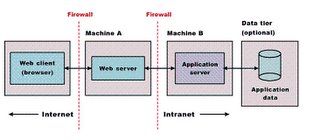
This allows m/c's hosted in the DMZ to interact with the external network for services such as Email, Web and DNS. So even if a host in the DMZ is compromised, the internal network is still safe. Connections from the external network to the DMZ are usually controlled using port address translation (PAT).
A DMZ can be created by connecting each network to different ports of a single firewall (3-legged-firewall) or by having 2 firewalls and the area btw them as a DMZ.
In case of Enterprise Applications (3-layered), the webserver is placed in the DMZ. This protects the applications business logic and database from intruder attacks.

Friday, February 24, 2006
Citrix Server and Terminal Services
I was quite familiar with Terminal Services in Windows and also the Remote Desktop Protocol used in it. But recently I came across a technology called 'Citrix' that was similar in nature, so I decided to dig into the root of it. This is the info I found on the net:
Citrix Presentation ServerSoftware from Citrix that provides a timeshared, multiuser environment for Unix and Windows servers. Formerly MetaFrame, Citrix Presentation Server uses the ICA protocol to turn the client machine into a terminal and governs the input/output between the client and server. Applications can also be run from a Web browser
Citrix Presentation Server (formerly Citrix MetaFrame) is a remote access/application publishing product built on the Independent Computing Architecture (ICA), Citrix Systems' thin client protocol. The Microsoft Remote Desktop Protocol, part of Microsoft's Terminal Services, is based on Citrix technology and was licensed from Citrix in 1997. Unlike traditional framebuffered protocols like VNC, ICA transmits high-level window display information, much like the X11 protocol, as opposed to purely graphical information.
Independent Computing Architecture (ICA) is a proprietary protocol for an application server system, designed by Citrix Systems. The protocol lays down a specification for passing data between server and clients, but is not bound to any one platform.
Practical products conforming to ICA are Citrix's WinFrame and MetaFrame products. These permit ordinary Windows applications to be run on a suitable Windows server, and for any supported client to gain access to those applications. The client platforms need not run Windows, there are clients for Mac and Unix for example.
Citrix Presentation ServerSoftware from Citrix that provides a timeshared, multiuser environment for Unix and Windows servers. Formerly MetaFrame, Citrix Presentation Server uses the ICA protocol to turn the client machine into a terminal and governs the input/output between the client and server. Applications can also be run from a Web browser
Citrix Presentation Server (formerly Citrix MetaFrame) is a remote access/application publishing product built on the Independent Computing Architecture (ICA), Citrix Systems' thin client protocol. The Microsoft Remote Desktop Protocol, part of Microsoft's Terminal Services, is based on Citrix technology and was licensed from Citrix in 1997. Unlike traditional framebuffered protocols like VNC, ICA transmits high-level window display information, much like the X11 protocol, as opposed to purely graphical information.
Independent Computing Architecture (ICA) is a proprietary protocol for an application server system, designed by Citrix Systems. The protocol lays down a specification for passing data between server and clients, but is not bound to any one platform.
Practical products conforming to ICA are Citrix's WinFrame and MetaFrame products. These permit ordinary Windows applications to be run on a suitable Windows server, and for any supported client to gain access to those applications. The client platforms need not run Windows, there are clients for Mac and Unix for example.
Tuesday, January 31, 2006
Tibco RV vs Tibco EMS
A lot of people are familiar with the Tibco RV (Rendezvous) product. This product is around 20 years old and powers many mission critical systems across different domains. Tibco has another product called Tibco EMS (Enterprise messaging Server) which is based on the JMS hub-and-spoke model and is quite popular in EAI. So what's the difference btw the two products? - When to use what ?
First we need to understand the differences in the architecture between the two products. Tibco RV is based on the multicast publish/subscribe model, where as Tibco EMS is based on the hub-and-spoke model.
Multicast is the delivery of information to a group of destinations simultaneously using the most efficient strategy to deliver the messages over each link of the network only once and only create copies when the links to the destinations split. By comparison with multicast, conventional point-to-single-point delivery is called unicast. When unicast is used to deliver to several recipients, a copy of the data is sent from the sender to each recipient, resulting in inefficient and badly scalable duplication at the sending side.
Googled out a white paper that contained some good architecture details about Tibco RV. The link is here.
Excerpt from the article:
TIB/RV is based on a distributed architecture . An installation of TIB/RV resides on each host on the network.Hence it eliminates the bottlenecks and single points offailures could be handled. It allows programs to sendmessages in a reliable, certified and transactional manner,depending on the requirements. Messaging can be delivered in point-to-point or publish/subscribe, synchronously orasynchronously, locally delivered or sent via WAN or theInternet. Rendezvous messages are self-describing and platform independent.
RVD (Rendezvous Daemon) is a background process that sits in between the RVprogram and the network. It is responsible for the deliveryand the acquisition of messages, either in point-to-point or publish/subscribe message domain. It is the most important component of the whole TIB/RV.Theoretically, there is an installation of RVD on every host on the network. However, it is possible to connect to a remote daemon, which sacrifices performance and transparencies. The RV Sender program passes the message and destination topic to RVD. RVD then broadcasts this message using User Data Packet(UDP) to the entire network. All subscribing computers with RVDs on the network will receive this message. RVD will filter the messages which non-subscribers will not be notified of the message. Therefore only subscriber programs to the particular topic will get the messages.
So when to use Tibco RV and when to use Tibco EMS (or any other hub-and-spoke model). An article at http://eaiblueprint.com/3.0/?p=17 describes the trade-offs between the two models:
Excerpt:
In my opinion, the multicast-based publish/subscribe messaging is an excellent solution for near-real-time message dissemination when 1 to 'very-many' delivery capabilities matter. RV originated on the trading floors as a vehicle for disseminating financial information such as stock prices.
However, in most EAI cases the opposite requirements are true:
‘Cardinality’ of message delivery is 1-1, 1-2; 1 to-very-many is a rare case. With exception of ‘consolidated application’ integration model (near real time request reply with timeout heuristics), reliability of message delivery takes priority over performance. Effectively, in most EAI implementations of RV, RV ends up simulating a queueing system using its ‘Certified Delivery’ mechanism. While this works, it is a flawed solution (see the discussion of Certified Messaging below).
Reliable delivery is a ‘native’ function of hub-and-spoke solutions. The multicast solution must be augmented with local persistence mechanism and re-try mechanism.
While RV offers reliable delivery (queueing) referred to as Certified Messaging, this solution is flawed in that: Inherently, reliability of CM is not comparable to the hub-and-spoke topologies as the data is stored in local file systems using non-transactional disk operations, as opposed to centralized database in hub-and-spoke topology. Corruption of RV ‘ledger files’ is not a rare case that leads to loss of data. Temporal de-coupling is not the case. While a message can be queue for a later delivery (in case the target system is unavailable), for a message to be actually delivered both system must be up at the same time.
RV / CM lacks a basic facility of any queueing system: a queue browser that is frequently required for production support (for example, in order to remove an offending message). In contrast, MQ Series offers an out-of the box queue browser and a host of third party solutions. Transactional messaging is difficult to implement in multicast environment. TIBCO offers a transactional augmentation of RV (RVTX) that guarantees a 1-and-onlu-once delivery; however, this solution essentially converts RV into a hub-and-spoke system. Consequently, very few RV implementations are transactional.
Having said that, the shortcomings of hub and spoke include:
First we need to understand the differences in the architecture between the two products. Tibco RV is based on the multicast publish/subscribe model, where as Tibco EMS is based on the hub-and-spoke model.
Multicast is the delivery of information to a group of destinations simultaneously using the most efficient strategy to deliver the messages over each link of the network only once and only create copies when the links to the destinations split. By comparison with multicast, conventional point-to-single-point delivery is called unicast. When unicast is used to deliver to several recipients, a copy of the data is sent from the sender to each recipient, resulting in inefficient and badly scalable duplication at the sending side.
Googled out a white paper that contained some good architecture details about Tibco RV. The link is here.
Excerpt from the article:
TIB/RV is based on a distributed architecture . An installation of TIB/RV resides on each host on the network.Hence it eliminates the bottlenecks and single points offailures could be handled. It allows programs to sendmessages in a reliable, certified and transactional manner,depending on the requirements. Messaging can be delivered in point-to-point or publish/subscribe, synchronously orasynchronously, locally delivered or sent via WAN or theInternet. Rendezvous messages are self-describing and platform independent.
RVD (Rendezvous Daemon) is a background process that sits in between the RVprogram and the network. It is responsible for the deliveryand the acquisition of messages, either in point-to-point or publish/subscribe message domain. It is the most important component of the whole TIB/RV.Theoretically, there is an installation of RVD on every host on the network. However, it is possible to connect to a remote daemon, which sacrifices performance and transparencies. The RV Sender program passes the message and destination topic to RVD. RVD then broadcasts this message using User Data Packet(UDP) to the entire network. All subscribing computers with RVDs on the network will receive this message. RVD will filter the messages which non-subscribers will not be notified of the message. Therefore only subscriber programs to the particular topic will get the messages.
So when to use Tibco RV and when to use Tibco EMS (or any other hub-and-spoke model). An article at http://eaiblueprint.com/3.0/?p=17 describes the trade-offs between the two models:
Excerpt:
In my opinion, the multicast-based publish/subscribe messaging is an excellent solution for near-real-time message dissemination when 1 to 'very-many' delivery capabilities matter. RV originated on the trading floors as a vehicle for disseminating financial information such as stock prices.
However, in most EAI cases the opposite requirements are true:
‘Cardinality’ of message delivery is 1-1, 1-2; 1 to-very-many is a rare case. With exception of ‘consolidated application’ integration model (near real time request reply with timeout heuristics), reliability of message delivery takes priority over performance. Effectively, in most EAI implementations of RV, RV ends up simulating a queueing system using its ‘Certified Delivery’ mechanism. While this works, it is a flawed solution (see the discussion of Certified Messaging below).
Reliable delivery is a ‘native’ function of hub-and-spoke solutions. The multicast solution must be augmented with local persistence mechanism and re-try mechanism.
While RV offers reliable delivery (queueing) referred to as Certified Messaging, this solution is flawed in that: Inherently, reliability of CM is not comparable to the hub-and-spoke topologies as the data is stored in local file systems using non-transactional disk operations, as opposed to centralized database in hub-and-spoke topology. Corruption of RV ‘ledger files’ is not a rare case that leads to loss of data. Temporal de-coupling is not the case. While a message can be queue for a later delivery (in case the target system is unavailable), for a message to be actually delivered both system must be up at the same time.
RV / CM lacks a basic facility of any queueing system: a queue browser that is frequently required for production support (for example, in order to remove an offending message). In contrast, MQ Series offers an out-of the box queue browser and a host of third party solutions. Transactional messaging is difficult to implement in multicast environment. TIBCO offers a transactional augmentation of RV (RVTX) that guarantees a 1-and-onlu-once delivery; however, this solution essentially converts RV into a hub-and-spoke system. Consequently, very few RV implementations are transactional.
Having said that, the shortcomings of hub and spoke include:
- Single point of failure, when the hub is down, everything is down. MQ Series addresses this problem by providing high-reliability clustering.
- Non-native publish/subscriber (publish/subscribe is emulated programmatically ) that results in reduced performance, especially in 1-to-very many delivery
- Overhead of hub management (a need for administering hub objects: queues, channels, etc).
- Inferior performance, especially in 1 to-many publish/subscribe and request/reply cases.
These shortcomings — in my opinion — do not outweigh benefits and for that reason MQ Series / hub-and-spoke solutions constitute a better choice for most EAI problem. Multicast-based publish subscribe is better left to its niches (high volume, high performance, accepter unreliability, 1 to very many).
Monday, January 30, 2006
ATMI vs Corba OTS
Recently while working on BEA Tuxedo server, I came across the term 'ATMI' - Application to Transaction Monitor Interface. I beleive Tux was quite a popular product for handling large number of transactions in a distributed environment - right from the early days when most business critical applications were written in Cobol.
ATMI is a procedural, non object oriented API that you use to write stateless services to manage transactions. This API is developed by the OpenGroup and forms the core service API of Tuxedo. The Application-Transaction Monitor Interface (ATMI) provides the interface between the COBOL application and the transaction processing system. This interface is known as ATMI and these pages specify its COBOL language binding. It provides routines to open and close resources, manage transactions, manage record types, and invoke request/response and conversational service calls.
But I believe today's TP monitors are based on Corba OTS (Object Transaction service) semantics. Corba OTS is used by any OO application as the underlying semantics for communications with resouce managers in a distributed transaction. Even JTS is the Java langauge mapping of Corba OTS. A JTS transaction manager implements the Java mappings of the CORBA OTS 1.1 specification, specifically, the Java packages org.omg.CosTransactions and org.omg.CosTSPortability. A JTS transaction manager can propagate transaction contexts to another JTS transaction manager via IIOP.
ATMI is a procedural, non object oriented API that you use to write stateless services to manage transactions. This API is developed by the OpenGroup and forms the core service API of Tuxedo. The Application-Transaction Monitor Interface (ATMI) provides the interface between the COBOL application and the transaction processing system. This interface is known as ATMI and these pages specify its COBOL language binding. It provides routines to open and close resources, manage transactions, manage record types, and invoke request/response and conversational service calls.
But I believe today's TP monitors are based on Corba OTS (Object Transaction service) semantics. Corba OTS is used by any OO application as the underlying semantics for communications with resouce managers in a distributed transaction. Even JTS is the Java langauge mapping of Corba OTS. A JTS transaction manager implements the Java mappings of the CORBA OTS 1.1 specification, specifically, the Java packages org.omg.CosTransactions and org.omg.CosTSPortability. A JTS transaction manager can propagate transaction contexts to another JTS transaction manager via IIOP.
Friday, January 27, 2006
Having both HTTP and HTTPS in a web-application
Web applications often need to have both http and https access; i.e. some URIs in the web application need to have HTTPS access and some can do with HTTP.
Hard-coding the URL address with https whereever required is not an elegant solution as this has to be reflected in all the links in all pages. An alternative soln will be to do a Response.redirect from the page with https in the URL. More detailed info is available at :
http://www.javaworld.com/javaworld/jw-02-2002/jw-0215-ssl.html
Also Struts has a extension through which we can specify which URLs need HTTPS access. For more info check out:
http://struts.apache.org/struts-taglib/ssl.html
http://sslext.sourceforge.net/
Hard-coding the URL address with https whereever required is not an elegant solution as this has to be reflected in all the links in all pages. An alternative soln will be to do a Response.redirect from the page with https in the URL. More detailed info is available at :
http://www.javaworld.com/javaworld/jw-02-2002/jw-0215-ssl.html
Also Struts has a extension through which we can specify which URLs need HTTPS access. For more info check out:
http://struts.apache.org/struts-taglib/ssl.html
http://sslext.sourceforge.net/
Java Service Wrapper
Came across this tool that can be used to run Java apps as a Windows Service or Unix deamon.
Includes fault correction software to automatically restart crashed or frozen JVMs. Critical when app is needed 24x7. Built for flexibility.
The following links provide more info:
http://sourceforge.net/projects/wrapper/ http://wrapper.tanukisoftware.org/doc/english/introduction.html
Includes fault correction software to automatically restart crashed or frozen JVMs. Critical when app is needed 24x7. Built for flexibility.
The following links provide more info:
http://sourceforge.net/projects/wrapper/ http://wrapper.tanukisoftware.org/doc/english/introduction.html
How to gaurantee "Once-and-only-once" delivery in JMS
In one application scenario, it was required to process the message only once. The message contained a donation amount that needed to be put in the database. Using a Queue and AUTO_ACK semantics, we were able to achieve this. But there was a problem - What would happen if the JMS provider fails before the acknowledgement is received from client. It would send the message again when it comes up. How to avoid this ?
The consumer may receive the message again, because when delivery is guaranteed, it's better to risk delivering a message twice than to risk losing it entirely. A redelivered message will have the JMSRedelivered flag set. A client application can check this flag by calling the getJMSRedelivered() method on the Message object. Only the most recent message received is subject to this ambiguity.
The consumer may receive the message again, because when delivery is guaranteed, it's better to risk delivering a message twice than to risk losing it entirely. A redelivered message will have the JMSRedelivered flag set. A client application can check this flag by calling the getJMSRedelivered() method on the Message object. Only the most recent message received is subject to this ambiguity.
What are XA transactions? What is a XA datasource?
Came across this wonderful explanation by Mike regarding XA transactions here
Excerpt:
An XA transaction, in the most general terms, is a "global transaction" that may span multiple resources. A non-XA transaction always involves just one resource. An XA transaction involves a coordinating transaction manager, with one or more databases (or other resources, like JMS) all involved in a single global transaction. Non-XA transactions have no transaction coordinator, and a single resource is doing all its transaction work itself (this is sometimes called local transactions).
XA transactions come from the X/Open group specification on distributed, global transactions. JTA includes the X/Open XA spec, in modified form. Most stuff in the world is non-XA - a Servlet or EJB or plain old JDBC in a Java application talking to a single database. XA gets involved when you want to work with multiple resources - 2 or more databases, a database and a JMS connection, all of those plus maybe a JCA resource - all in a single transaction. In this scenario, you'll have an app server like Websphere or Weblogic or JBoss acting as the Transaction Manager, and your various resources (Oracle, Sybase, IBM MQ JMS, SAP, whatever) acting as transaction resources. Your code can then update/delete/publish/whatever across the many resources. When you say "commit", the results are commited across all of the resources. When you say "rollback", _everything_ is rolled back across all resources.
The Transaction Manager coordinates all of this through a protocol called Two Phase Commit (2PC). This protocol also has to be supported by the individual resources. In terms of datasources, an XA datasource is a data source that can participate in an XA global transaction. A non-XA datasource generally can't participate in a global transaction (sort of - some people implement what's called a "last participant" optimization that can let you do this for exactly one non-XA item).
Excerpt:
An XA transaction, in the most general terms, is a "global transaction" that may span multiple resources. A non-XA transaction always involves just one resource. An XA transaction involves a coordinating transaction manager, with one or more databases (or other resources, like JMS) all involved in a single global transaction. Non-XA transactions have no transaction coordinator, and a single resource is doing all its transaction work itself (this is sometimes called local transactions).
XA transactions come from the X/Open group specification on distributed, global transactions. JTA includes the X/Open XA spec, in modified form. Most stuff in the world is non-XA - a Servlet or EJB or plain old JDBC in a Java application talking to a single database. XA gets involved when you want to work with multiple resources - 2 or more databases, a database and a JMS connection, all of those plus maybe a JCA resource - all in a single transaction. In this scenario, you'll have an app server like Websphere or Weblogic or JBoss acting as the Transaction Manager, and your various resources (Oracle, Sybase, IBM MQ JMS, SAP, whatever) acting as transaction resources. Your code can then update/delete/publish/whatever across the many resources. When you say "commit", the results are commited across all of the resources. When you say "rollback", _everything_ is rolled back across all resources.
The Transaction Manager coordinates all of this through a protocol called Two Phase Commit (2PC). This protocol also has to be supported by the individual resources. In terms of datasources, an XA datasource is a data source that can participate in an XA global transaction. A non-XA datasource generally can't participate in a global transaction (sort of - some people implement what's called a "last participant" optimization that can let you do this for exactly one non-XA item).
Wednesday, January 25, 2006
Message Driven Beans Vs Stand-alone JMS clients
In many design scenarios, asynchronous messaging is required- for integration purposes, for handling large volume of requests etc.
In the J2EE scenario, we often have to decide whether to write a simple JMS client or go for a MDB in a EJB container. Though, a simple JMS client is neat and easy to write, it has some disadvantages:
JMS has no built-in mechanism to handle more than one incoming request at a time. To support concurrent requests, you will need to extend the JMS client to spawn multiple threads, or launch multiple JVM instances, each running the application.On the downside, we have issues of security, transaction handling, and scalability.
The main advantage that MDBs have over simple JMS message consumers is that the EJB container can instantiate multiple MDB instances to handle multiple messages simultaneously.
A message-driven bean (MDB) acts as a JMS message listener. MDBs are different from session beans and entity beans because they have no remote, remote home, local, or local home interfaces. They are similar to other bean types in that they have a bean implementation, they are defined in the ejb-jar.xml file, and they can take advantage of EJB features such as transactions, security, and lifecycle management.
As a full-fledged JMS client, MDBs can both send and receive messages asynchronously via a MOM server. As an enterprise bean, MDBs are managed by the container and declaratively configured by an EJB deployment descriptor.
For instance, a JMS client could send a message to an MDB (which is constantly online awaiting incoming messages), which in turn could access a session bean or a handful of entity beans. In this way, MDBs can be used as a sort of an asynchronous wrapper, providing access to business processes that could previously be accessed only via a synchronous RMI/IIOP call.
Because they are specifically designed as message consumers and yet are still managed by the EJB container, MDBs offer a tremendous advantage in terms of scalability. Because message beans are stateless and managed by the container, they can both send and receive messages concurrently (the container simply grabs another bean out of the pool). This, combined with the inherent scalability of EJB application servers, produces a very robust and scalable enterprise messaging solution.
They cannot be invoked in any manner other than via a JMS message. This means that they are ideally suited as message consumers, but not necessarily as message producers. Message-driven beans can certainly send messages, but only after first being invoked by an incoming request. Also, MDBs are currently designed to map to only a single JMS destination. They listen for messages on that destination only.
When a message-driven bean's transaction attribute is set to Required, then the message delivery from the JMS destination to the message-driven bean is part of the subsequent transactional work undertaken by the bean. By having the message-driven bean be part of a transaction, you ensure that message delivery takes place. If the subsequent transactional work that the message-driven bean starts does not go to completion, then, when the container rolls back that transactional work it also puts the message back in its destination so that it can be picked up later by another message-driven bean instance.
One limitation of message-driven beans compared to standard JMS listeners is that you can associate a given message-driven bean deployment with only one Queue or Topic
If your application requires a single JMS consumer to service messages from multiple Queues or Topics, you must use a standard JMS consumer, or deploy multiple message-driven bean classes.
In the J2EE scenario, we often have to decide whether to write a simple JMS client or go for a MDB in a EJB container. Though, a simple JMS client is neat and easy to write, it has some disadvantages:
JMS has no built-in mechanism to handle more than one incoming request at a time. To support concurrent requests, you will need to extend the JMS client to spawn multiple threads, or launch multiple JVM instances, each running the application.On the downside, we have issues of security, transaction handling, and scalability.
The main advantage that MDBs have over simple JMS message consumers is that the EJB container can instantiate multiple MDB instances to handle multiple messages simultaneously.
A message-driven bean (MDB) acts as a JMS message listener. MDBs are different from session beans and entity beans because they have no remote, remote home, local, or local home interfaces. They are similar to other bean types in that they have a bean implementation, they are defined in the ejb-jar.xml file, and they can take advantage of EJB features such as transactions, security, and lifecycle management.
As a full-fledged JMS client, MDBs can both send and receive messages asynchronously via a MOM server. As an enterprise bean, MDBs are managed by the container and declaratively configured by an EJB deployment descriptor.
For instance, a JMS client could send a message to an MDB (which is constantly online awaiting incoming messages), which in turn could access a session bean or a handful of entity beans. In this way, MDBs can be used as a sort of an asynchronous wrapper, providing access to business processes that could previously be accessed only via a synchronous RMI/IIOP call.
Because they are specifically designed as message consumers and yet are still managed by the EJB container, MDBs offer a tremendous advantage in terms of scalability. Because message beans are stateless and managed by the container, they can both send and receive messages concurrently (the container simply grabs another bean out of the pool). This, combined with the inherent scalability of EJB application servers, produces a very robust and scalable enterprise messaging solution.
They cannot be invoked in any manner other than via a JMS message. This means that they are ideally suited as message consumers, but not necessarily as message producers. Message-driven beans can certainly send messages, but only after first being invoked by an incoming request. Also, MDBs are currently designed to map to only a single JMS destination. They listen for messages on that destination only.
When a message-driven bean's transaction attribute is set to Required, then the message delivery from the JMS destination to the message-driven bean is part of the subsequent transactional work undertaken by the bean. By having the message-driven bean be part of a transaction, you ensure that message delivery takes place. If the subsequent transactional work that the message-driven bean starts does not go to completion, then, when the container rolls back that transactional work it also puts the message back in its destination so that it can be picked up later by another message-driven bean instance.
One limitation of message-driven beans compared to standard JMS listeners is that you can associate a given message-driven bean deployment with only one Queue or Topic
If your application requires a single JMS consumer to service messages from multiple Queues or Topics, you must use a standard JMS consumer, or deploy multiple message-driven bean classes.
Tuesday, January 17, 2006
On Screen Scraping
Recently I came across the term "Screen Scraping" when interfacing with a legacy application. I was not really sure what it mean in the context of EAI.. A google search came up with a good explanation at http://en.wikipedia.org/wiki/Screen_scraping
As a concrete example of a classic screen scraper, consider a hypothetical legacy system dating from the 1960s -- the dawn of computerized data processing. Computer to user interfaces from that era were often simply text-based dumb terminals which were not much more than virtual teleprinters. (Such systems are still in use today, for various reasons.) The desire to interface such a system to more modern systems is common. An elegant solution will often require things no longer available, such as source code, system documentation, APIs, and/or programmers with experience in a 45 year old computer system. In such cases, the only feasible solution may be to write a screen scraper which "pretends" to be a user at a terminal. The screen scraper might connect to the legacy system via Telnet, emulator the keystrokes needed to navigate the old user interface, process the resulting display output, extract the desired data, and pass it on to the modern system.
As a concrete example of a classic screen scraper, consider a hypothetical legacy system dating from the 1960s -- the dawn of computerized data processing. Computer to user interfaces from that era were often simply text-based dumb terminals which were not much more than virtual teleprinters. (Such systems are still in use today, for various reasons.) The desire to interface such a system to more modern systems is common. An elegant solution will often require things no longer available, such as source code, system documentation, APIs, and/or programmers with experience in a 45 year old computer system. In such cases, the only feasible solution may be to write a screen scraper which "pretends" to be a user at a terminal. The screen scraper might connect to the legacy system via Telnet, emulator the keystrokes needed to navigate the old user interface, process the resulting display output, extract the desired data, and pass it on to the modern system.
Thursday, December 29, 2005
About Daemon Threads in Java
Came across this cool article about Daemon Threads at http://www.absolutejava.com/main-articles/beware-the-daemons/
I knew that the VM does not exit as long as there is one non-daemon thread running. But there were a couple of new things I learned. Some snippets from the above article:
There are two ways a thread can become a daemon thread (or a user thread, for that matter) without putting your soul at risk. First, you can explicitly specify a thread to be a daemon thread by calling setDaemon(true) on a Thread object. Note that the setDaemon() method must be called before the thread's start() method is invoked.Once a thread has started executing (i.e., its start() method has been called) its daemon status cannot be changed.
The second technique for creating a daemon thread is based on an often overlooked feature of Java's threading behavior: If a thread creates a new thread and does not call setDaemon() to explicitlly set the new thread's "daemon status", the new thread inherits the "daemon-status" of the thread that created it. In other words, unless setDaemon(false) is called, all threads created by daemon threads will be daemon threads; similarly, unless setDaemon(true) is called, all threads created by user threads will be user threads.
I knew that the VM does not exit as long as there is one non-daemon thread running. But there were a couple of new things I learned. Some snippets from the above article:
There are two ways a thread can become a daemon thread (or a user thread, for that matter) without putting your soul at risk. First, you can explicitly specify a thread to be a daemon thread by calling setDaemon(true) on a Thread object. Note that the setDaemon() method must be called before the thread's start() method is invoked.Once a thread has started executing (i.e., its start() method has been called) its daemon status cannot be changed.
The second technique for creating a daemon thread is based on an often overlooked feature of Java's threading behavior: If a thread creates a new thread and does not call setDaemon() to explicitlly set the new thread's "daemon status", the new thread inherits the "daemon-status" of the thread that created it. In other words, unless setDaemon(false) is called, all threads created by daemon threads will be daemon threads; similarly, unless setDaemon(true) is called, all threads created by user threads will be user threads.
Monday, December 26, 2005
Debug information in Java .class files
I have often wanted to learn more about the class file format of Java class files. This study let me to interesting discoveries - regarding what debug information is stored in class files and how it is stored.
When we compile a Java source using the 'javac' exe, the generated class file by default contains some debug info - By default, only the line number and source file information is generated.
Hence when a stack trace is printed on the screen, we can see the source file name and the line number also printed on the screen. Also, when using log4J, I remember using a layout which can print the line number of each log statement - I bet log4J uses the debug infomation present in the class file to do this.
The javac exe also has a '-g' option - This option generates all debugging information, including local variables. To understand this better, I compiled a java source twice; once with the -g option and once without. I then decompiled both the class files to see how the decompiled output differs. The class file compiled with the debug option, showed all the local variable names same as in the original Java file, whereas the one without the debug option, had the local variables named by the decompiler as the local variable information was not stored in the class file.
Another interesting fact is that the class file can contain certain attributes that are non-standard; i.e. vendor specific. Suprised !!!...So was I..Please find below a snippet from the VM spec :
Compilers for Java source code are permitted to define and emit class files containing new attributes in the attributes tables of class file structures. Java Virtual Machine implementations are permitted to recognize and use new attributes found in the attributes tables of class file structures. However, all attributes not defined as part of this Java Virtual Machine specification must not affect the semantics of class or interface types. Java Virtual Machine implementations are required to silently ignore attributes they do not recognize.
For instance, defining a new attribute to support vendor-specific debugging is permitted. Because Java Virtual Machine implementations are required to ignore attributes they do not recognize, class files intended for that particular Java Virtual Machine implementation will be usable by other implementations even if those implementations cannot make use of the additional debugging information that the class files contain
When we compile a Java source using the 'javac' exe, the generated class file by default contains some debug info - By default, only the line number and source file information is generated.
Hence when a stack trace is printed on the screen, we can see the source file name and the line number also printed on the screen. Also, when using log4J, I remember using a layout which can print the line number of each log statement - I bet log4J uses the debug infomation present in the class file to do this.
The javac exe also has a '-g' option - This option generates all debugging information, including local variables. To understand this better, I compiled a java source twice; once with the -g option and once without. I then decompiled both the class files to see how the decompiled output differs. The class file compiled with the debug option, showed all the local variable names same as in the original Java file, whereas the one without the debug option, had the local variables named by the decompiler as the local variable information was not stored in the class file.
Another interesting fact is that the class file can contain certain attributes that are non-standard; i.e. vendor specific. Suprised !!!...So was I..Please find below a snippet from the VM spec :
Compilers for Java source code are permitted to define and emit class files containing new attributes in the attributes tables of class file structures. Java Virtual Machine implementations are permitted to recognize and use new attributes found in the attributes tables of class file structures. However, all attributes not defined as part of this Java Virtual Machine specification must not affect the semantics of class or interface types. Java Virtual Machine implementations are required to silently ignore attributes they do not recognize.
For instance, defining a new attribute to support vendor-specific debugging is permitted. Because Java Virtual Machine implementations are required to ignore attributes they do not recognize, class files intended for that particular Java Virtual Machine implementation will be usable by other implementations even if those implementations cannot make use of the additional debugging information that the class files contain
Friday, December 23, 2005
Select second highest record with a query
A friend of mine was asked in an interview to write a query to fetch the second highest marks in a table of students.
Well, I found out 2 ways to do this:
1) Using TOP to get the topmost 2 rows from the table in descending order and then again getting a TOP of the resultset.
SELECT TOP 1 *
FROM(SELECT TOP 2 *
FROM Table1
ORDER BY Marks desc)
ORDER BY Marks;
2) Using the MAX function. (I was suprised to see this work)
SELECT Max(Marks) FROM Table1
WHERE Marks Not In (SELECT MAX(Marks) FROM Table1);
Well, I found out 2 ways to do this:
1) Using TOP to get the topmost 2 rows from the table in descending order and then again getting a TOP of the resultset.
SELECT TOP 1 *
FROM(SELECT TOP 2 *
FROM Table1
ORDER BY Marks desc)
ORDER BY Marks;
2) Using the MAX function. (I was suprised to see this work)
SELECT Max(Marks) FROM Table1
WHERE Marks Not In (SELECT MAX(Marks) FROM Table1);
Hierarchical databases Vs Relational Databases
While designing a systems, I often came across the moot point of choosing btw a heirarchical database and a relational flat table database. There are some domain problems, where heirarchical databases such as LDAP and MS Directory Services make sense over RDBs.
The hierarchical database model existed before the far more familiar relational model in early mainframe days. Hierarchical databases were blown away by relational versions because it was difficult to model a many-to-many relationship - the very basis of the hierarchical model is that each child element has only one parent element.
In his article, Scott Ambler makes the following statement:
Hierarchical databases fell out of favor with the advent of relational databases due to their lack of flexibility because it wouldn’t easily support data access outside the original design of the data
structure. For example, in the customer-order schema you could only access an order through a customer, you couldn’t easily find all the orders that included the sale of a widget because the schema isn’t designed to all that.
I found an article on the microsoft site which discusses the areas where directory services can be used in place of Relational databases.
Some good candidates for heirarchical databases are- White pages" information, User credential & security group information, Network configuration and service policies, Application deployment policies etc.
The hierarchical database model existed before the far more familiar relational model in early mainframe days. Hierarchical databases were blown away by relational versions because it was difficult to model a many-to-many relationship - the very basis of the hierarchical model is that each child element has only one parent element.
In his article, Scott Ambler makes the following statement:
Hierarchical databases fell out of favor with the advent of relational databases due to their lack of flexibility because it wouldn’t easily support data access outside the original design of the data
structure. For example, in the customer-order schema you could only access an order through a customer, you couldn’t easily find all the orders that included the sale of a widget because the schema isn’t designed to all that.
I found an article on the microsoft site which discusses the areas where directory services can be used in place of Relational databases.
Some good candidates for heirarchical databases are- White pages" information, User credential & security group information, Network configuration and service policies, Application deployment policies etc.
Thursday, December 22, 2005
The beauty of Log4J
It took me sometime to appreciate the inheritance heirarchy in Log4J. It's quite simple to understand the Log Levels and their usage.
It is because of this heirarchy that we can have any arbitraty level of granularity in logging. For e.g. suppose we have 10 components in a distributed environment and we want to shutdown the logging of one component. This can be easily done in Log4J using config files. We can also disable logging at a class level - provided we have a Logger for that class - using the Logger.getLogger(this.class) method. Another example is if U want to switch off logging of one or more modules in a application.
We can even make dymanic changes in the configuration file at runtime and these changes would get reflected provided we have used the configureAndWatch() method.
It is because of this heirarchy that we can have any arbitraty level of granularity in logging. For e.g. suppose we have 10 components in a distributed environment and we want to shutdown the logging of one component. This can be easily done in Log4J using config files. We can also disable logging at a class level - provided we have a Logger for that class - using the Logger.getLogger(this.class) method. Another example is if U want to switch off logging of one or more modules in a application.
We can even make dymanic changes in the configuration file at runtime and these changes would get reflected provided we have used the configureAndWatch() method.
Subscribe to:
Posts (Atom)